Skip to content

Keratoconus Management in Child and Family Eye Care

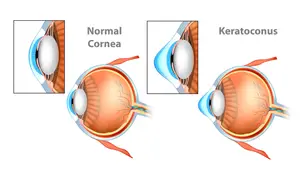
Keratoconus is a progressive eye condition that affects the shape of the cornea, the clear front surface of the eye. Instead of maintaining a smooth, round shape, the cornea gradually becomes thinner and bulges outward into a cone-like shape. This irregular shape causes distorted and blurry vision that often cannot be fully corrected with glasses alone.

At Child and Family Eye Care, we help patients in Child and Family Eye Care manage keratoconus with advanced specialty contact lenses designed to improve clarity, comfort, and quality of life.
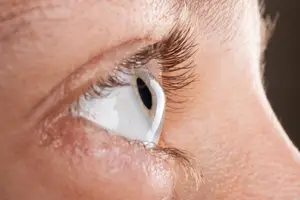
Close-up of a person's eye with a contact lens in place, showing a slightly irritated and red-looking eye with a tear drop on the eyelid.
Illustration of a normal cornea versus a cornea affected by keratoconus.

What is Keratoconus?

The cornea plays a critical role in focusing light onto the retina. When it becomes irregular, light does not focus properly, leading to distorted vision. Keratoconus typically begins in the teenage years or early adulthood and may progress over time.

Because the condition changes the structure of the cornea, patients often notice increasing prescription changes, worsening astigmatism, or vision that seems blurry even with updated glasses.

Early diagnosis and proper management are key to maintaining functional vision.

Common Symptoms of Keratoconus

Keratoconus can develop gradually, and symptoms may change as the condition progresses. Common signs include:

  • Blurred or distorted vision
  • Increased sensitivity to light
  • Frequent changes in glasses prescription
  • Glare and halos around lights
  • Difficulty seeing clearly at night
  • Double or ghosted images

If these symptoms sound familiar, a comprehensive eye exam at Child and Family Eye Care in Child and Family Eye Care can determine whether keratoconus is the cause.

Black glasses on an open book
Man adjusting glasses with a serious look on his face

Why Glasses Are Often Not Enough

In early stages, glasses may improve vision temporarily. However, as keratoconus progresses and the cornea becomes more irregular, glasses are often no longer effective.

Glasses sit in front of the eye and cannot compensate for the uneven surface of a cone-shaped cornea. Specialty contact lenses, on the other hand, rest directly on the eye and create a new, smooth optical surface that allows light to focus more accurately.

This is why specialty lenses are often the preferred non-surgical treatment for keratoconus.

Specialty Contact Lenses for Keratoconus

Managing keratoconus with specialty contact lenses is highly effective for many patients. These lenses are custom designed to fit the unique shape of the cornea and provide clearer, more stable vision.

Several types of specialty lenses may be recommended, depending on the severity of the condition and individual comfort needs:

Rigid gas-permeable lenses create a smooth refracting surface over the cornea to improve clarity.

Scleral lenses vault over the cornea and rest on the white part of the eye, offering improved comfort and stability for patients with more advanced keratoconus.

Hybrid lenses combine a firm center with a soft outer skirt for patients who want both clarity and comfort.

Each lens type is carefully selected and fitted to ensure the best possible visual outcome.

A hand pointing to a contact lens on a blue background
A woman sitting on a couch with a smile on her face

The Importance of a Custom Fit

Specialty contact lens fittings for keratoconus require advanced measurements and precise customization. A standard contact lens exam is not sufficient.

At Child and Family Eye Care, our team uses detailed corneal mapping and evaluation techniques to assess the shape and health of the cornea. This allows us to design lenses that provide optimal vision while maintaining corneal health.

A proper fit improves comfort, reduces irritation, and enhances long-term success with lens wear.

Can Keratoconus Be Cured?

There is currently no cure that reverses keratoconus, but it can be effectively managed. In some cases, corneal cross-linking may be recommended to help slow progression. However, even after cross-linking, many patients still rely on specialty contact lenses to achieve their best vision.

Regular monitoring at Child and Family Eye Care in Child and Family Eye Care is essential to track changes and adjust treatment as needed.

Living Well With Keratoconus

A diagnosis of keratoconus can feel overwhelming at first, especially for young patients and parents. The good news is that most individuals with keratoconus can achieve excellent functional vision with the right management plan.

Specialty contact lenses allow patients in Child and Family Eye Care to continue school, work, sports, and daily activities with clearer and more stable vision. Early care and consistent follow-up make a significant difference in long-term outcomes.

Close-up of a man holding a contact lens with a light background

Schedule Your Eye Exam in Child and Family Eye Care

If you have been diagnosed with keratoconus or suspect your changing vision may be related to corneal irregularity, a comprehensive evaluation is the first step.

Child and Family Eye Care provides advanced specialty contact lens fittings for keratoconus in Child and Family Eye Care. Our team is committed to personalized care and long-term vision management. Call today to book your next appointment.