
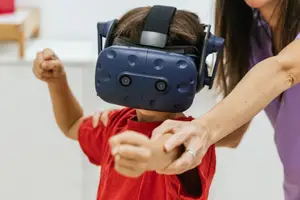
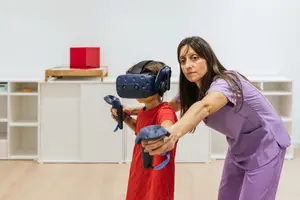
At Child and Family Eye Care, we integrate virtual reality (VR) into select vision therapy programs to support focus, engagement, and real-time skill development. These immersive tools help patients strengthen the coordination between their eyes and their brains.
VR-Based Vision Therapy That Engages, Trains, & Tracks Progress
How VR Enhances Vision Therapy
VR-based therapy allows us to simulate controlled visual environments where patients can work on core visual skills, like tracking, depth perception, convergence, and focus flexibility, in a setting that’s both immersive and structured.
Instead of repetitive paper-based drills or isolated tasks, VR helps us connect therapy goals to real-world visual challenges.
We use these programs to:
- Increase motivation in younger patients
- Provide immediate feedback on eye movement and response
- Reduce distractions so patients can stay focused
- Add variety to therapy sessions without losing clinical intent
- Reinforce functional gains through repetition and progress tracking
Who Benefits from VR-Based Programs?
VR-based vision therapy is helpful for both children and adults who need more support with engagement, consistency, or focus, especially when traditional methods feel frustrating or slow.
It’s often a good fit for:
- Children or teens with short attention spans or sensory needs.
- Patients with convergence or tracking difficulties who benefit from guided repetition.
- Athletes in sports vision programs building depth perception and peripheral awareness.
- Adults recovering from a concussion or brain injury who need low-stress but structured therapy.
- Anyone who responds better to visual, interactive learning environments.


What to Expect From VR Sessions at Meta Vision
During a typical VR-integrated session, patients will:
- Work through selected programs based on their care goals
- Receive gentle guidance and redirection as needed
- Take breaks when fatigue sets in
- See how their skills improve over time through both performance and comfort
For many patients, VR helps reduce resistance and increase confidence, especially when they’ve struggled with more traditional approaches.
VR-Integrated Vision Therapy in Magnolia at Meta Vision
Our VR-based programs are available exclusively through the Meta Vision clinic inside our Magnolia office. This clinic was built for focused, one-on-one vision therapy in a calm, supportive environment.
Whether you’re a parent looking for ways to help your child stay engaged in therapy or an adult trying to rebuild visual function after an injury, we’re here to walk through it with you, one session at a time.